Showing posts with label Austrians are Weird. Show all posts

25 February 2011

Austrian Gemütlichkeit

It's hard for me to believe that with so many great words in the German language, I've yet to devote an entire post to explaining one word.  But here goes:

Like many useful German words, gemütlichkeit has no real equivalent in English.  It refers to a lifestyle that is some combination of comfort, coziness, relaxation, sociability, and enjoyment, mixed, perhaps, with a touch of laziness.  Overall it's a very foreign idea to Americans, who tend to value things like work, stress, meritocracy, very short lunch breaks, and insanely large cups of coffee.

Living in Austria has sapped some of my motivation, except
when it comes to blogging and napping.
To me, gemütlichkeit is one of the defining characteristics of Austrian culture; it also constitutes a major difference between Austria and a certain larger, less-Catholic German-speaking country in the neighborhood.  In fact, Austria is like a much snowier version of Spain, with many Austrian shops and businesses closing for several hours in the middle of the day for employees to take a break (although ritualistic napping is much less prevalent here).  Even some smaller cafes in Waidhofen close their doors between twelve and three in the afternoon, which you don't need to be an associate at the Boston Consulting Group to realize is not the best business strategy for a lunch place.

Then again, maximizing profits is not as emphasized in Austria as in the US - one Viennese entrepreneur named Richard Lugner, most famous for bringing hot American celebrities to the annual Opera Ball, appears to be the only Austrian who realizes or even cares how much money you could make be increasing the opening hours of shopping centers and grocery stores.  The Austrian Catholic Church, trade unions, and 81% of the Austrian population want nothing to do with commerce on Sundays.

Gemütlichkeit is also an especially pervasive attitude in the schools where I work.  Teachers are known for being >5 minutes late to their own classes ("I had to finish my coffee, it's not healthy to chug...") and students tend to be mysteriously ill on days when they are meant to make presentations.  Overall schools here are much more relaxed than in America, as I am frequently reminded on days when my classes are canceled because the students have unexpectedly all gone to the movies or are off on a multi-day ski trip.     

What's remarkable about Austria's gemütlichkeit is that, despite the fact that all employees enjoys a bare minimum of five weeks paid vacation per year (unvorstellbar in America!), plus thirteen paid public holidays, society still runs smoothly.  Unlike in Greece or Italy, trains are on time, garbage is picked up regularly, and even the employees at the tax office are helpful (assuming you visit them during the 25 hours per week that they're actually open).  Relaxation, apparently, does not impair efficiency.  Nor does drinking 13 liters of pure alcohol per year or retiring at age 58    

Austria proves that a society's quality of life can be extremely high, despite stress levels that are significantly lower than in America, where recent college grads have been known to to work 70 hours per week without any days off for several months unpaid for the sake of "experience."*  In fact, this stress differential may be why Austrians can eat so much fried food, cured meat, and saturated fat, yet still have a much lower incidence of heart disease than Americans.  Just a theory...

*q.v. Gabbi Greenfield's life           

01 February 2011

Very Austrian Things That I've Done So Far

Since arriving in September, I've...

-Waltzed to a live performance of the Baywatch Theme Song.  (The blatant lack of appropriate time signature does not deter Austrians from waltzing.)
Alpenhütte party atop nearby Prochenberg
-Enjoyed three-hour lunch breaks.
-Screamed at a stranger for failing to stand right, walk left on an U-Bahn escalator in Vienna.  I'm not normally this unfriendly, but I could not miss that train. 
-Hiked up a mountain, discovered an Alpenhütte (mountain hut) party, drank a beer, hiked back.
-Hiked a different mountain with Maggie, discovered a Gasthaus (guesthouse/inn), drank a beer, hiked back.  We also played a wooden glockenspiel on said mountain.
-Judged people for mentioning The Sound of Music.
-Demanded, with near immediate success, that a DJ play the #1 International Superhit Barbara Streisand.
-Bagged my own groceries every time.
-AND stayed in one cafe for a period of time so lengthy that I would have almost certainly been suspected of homelessness in the US.

25 January 2011

No Matter Where You Go, Some People Dress Like Fools...

Schematic Diagram of a
Krocha
Although America may be the place for misguided and foolish youth cultures, a bizarre minority specimen of Austrian teenager is worthy of comment.

They are called die Krocha* and their preferred habitat is the disco.  They are reminiscent in attitude of American "bros," especially because of their lust for clubbing and their taste for Ed Hardy wear (Keine Party ohne Ed Hardy, as they say). 

Three Krocha in their
natural environment
This resemblence to more familiar youth cultures does not extend to other aspects of their attire, many of which are distinctly European or, more accurately, "Eurotrash."  They favor white Adidas sneakers, extremely tight pants, and large key loops for wrapping around their right leg.  They sport finely manicured eyebrows, spray-on tans, and stiffly gelled hair, perhaps as protection from concussions received while dancing.  They also have an insatiable appetite for Palestinian checkered scarves (called Palästinensertuch in German), which they wear as mere accessories, with extreme indifference to potential political meaning.  

They have a language of their own and particularly enjoy the word Oida, which is rougly equivalent to "dude" or "man."  It is sometimes also used without context just to add some flavor to their almost certainly vacuous sentences.  Like popular American TV Chef Emeril Lagasse, they also like to use the word Bam frequently in order to demonstrate their extreme enthusiasm for another's enviable neon-colored baseball cap or impressive dance skills**.  The rest of their vocabulary is a mixture of Viennese (Wienerisch) and various migrant languages.

An urban Austrian phenomenon - I have encountered very few Krocha out here in the countryside and I don't have any as students.  According to German Wikipedia, only 1.7% of 11-29 year olds in Austria identify as Krocha, although I'm not sure how Wikipedia could have gotten this information and I doubt that Krocha is a checkable box in many surveys or censuses.  I've read reports that this style is fading into obscurity (thankfully, according to most accounts), but in my experience they remain common U-Bahn fixtures.  I have rarely seen them in daylight, which they seem to detest despite their remarkable tans.

*I think this word stems originally from the Wienerisch word for the Hochdeutsch hineinkrachen, which means "to encroach."  The word was Austria's second-place Word of the Year 2008, behind Lebensmensch.
**The "krochn" dance style goes best with music from the album krocha traxx vol. 1, available from Universal Music.

15 December 2010

You May Care, But It's Sausage to Me!

Sausages in Austria do not usually
have legs, clothing, or, notably,
emotions.
One of the most useful and versatile words that I've learned in Austrian dialect thus far is Wurst.  As you might guess, the word literally means "sausage," yet in Austria it is often used to communicate that the speaker doesn't care or doesn't know about a given topic or question.

Although I knew upon arrival that Austrians liked their sausages, it took me several weeks to realize why Austrians were always responding to my yes/no questions with the same cryptic reply - "sausage." 

According to unverified internet etymologies, this peculiar use of "sausage" has several conceivable origins.  Theory One states that the symmetry of sausages symbolizes one end of an issue being equal to the other.  Theory Two states that, because sausages are made of left-over or otherwise useless meats, "sausage" became an appropriate verbal response to anything you just don't know what to do with.  Theory Three states Austrians are always thinking about sausages, so when they are at a loss they simply say "sausage."

In order to insert this practical use of "sausage" into your English lexicon, here are some examples of its effective use:

In a restaurant:
Hostess: Smoking or non-smoking, sir?
You: Sausage.
Hostess: Thank you for being flexible.

Going Out:
You: What should I wear tonight, pants or a skirt?
A Friend: Mmm, sausage.
You: Yeah, I guess you're right.

On an airplane:
Flight Attendant: Would you prefer the fish or the beef for dinner?
You: Sausage.
Flight Attendant: And to drink?.
You: Also sausage.

Unfortunately my blog, like everything has an end. Only the sausage has two.  Wurst.

07 December 2010

Where the Future is Still in the Future

An Austrian friend of mine once joked that if the world came to an end, Austria wouldn't notice for five years.  Although a disco house track inexplicably titled "Barbara Streisand" has somehow become far and away the most popular song in Austria, the world has not yet come to an end.  Nonetheless, I have noticed that Austria is slow to pick up on some of the latest trends, at least when it comes to personal technology.

Austria certainly has an extraordinary standard of living and an advanced energy infrastructure, but when it comes to technology use in everday life, Austrians seem less cutting edge than Americans.  As I tend to be slightly techno-phobic, this is relieving for me at times.

While in America people are enjoying a new iPhone App that allows them to see what's in front of them while they are walking and typing, Austrians are more likely to send letters and almost always pay with cash.  Older Austrians tend not to have internet access and newspapers here are not facing the same budget crises as their American counterparts.  During a lesson on technology and new media, many of my students laughed at me for suggesting that VCRs were obsolete and few responded kindly to my crack at landline telephones.  In a country where most university-track students are still required to learn Latin, perhaps this conservative approach to technology is not surprising.
In Austria, old things work
and old people don't
 
I have also noticed a major divergence with regard to technology in schools.  While American education wonks are gaga for Smart Boards, PowerPoint, and standardized testing, both of my schools still rely on chalk (albeit chalk of many different colors) to hold students' attention.  Austrians teachers still write and grade their tests by hand and many scoff at the idea of Scantron machines.  But sometimes older technologies are the most reliable; as I've discovered, overhead projectors malfunction less frequently than computer labs and their finnicky projectors.  In fact, I've developed an unlikely romance for the overhead projector and I find it's really quite useful for teaching ESL.  Plus, as any student could tell you, there's just something about seeing your teacher's magnified spit froth on the big screen as he vigorously rubs the Vis-a-Vis off a slide with his many-colored thumb.


And a relevent relevant word of the day is die Zukunft, or "the future."  In German, I sometimes like to add the phrase der Zukunft, or "of the future," to nouns to make them sound more exciting.  For example Architekt der Zukunft - "Architecht of the Future."

01 December 2010

Atop City Hall

der Stadtturm, or "City Tower"
In the center of town here in Waidhofen there's a nice-looking clock tower attached to the town hall that I walk by on most days.  Recently  I noticed that it has a message written on it in Gothic script:

"Im Jahre 1532 schlugen Bürger, Schmiede, und Bauern die Türken in die Flucht und erbautern zur Errinerung diesen Turm." 

Which translates to:

"In the year 1532, townsmen, blacksmiths and farmers beat back the Turks and built this tower in their memory."

When I first read it I found to be a truly bad-ass message, although slightly incongruous with the Turkish kabob stand on the same block.  Given the anti-immigrant fervor of Austria's far-right political party, I thought it might also make a passable campaign message. 

29 November 2010

Sample Dialogue #2

On the street, in German.

Old Austrian Man: Excuse me, young man.  How tall are you?
Scott: (pause to convert to metric) One meter ninety-three.
Old Austrian Man: So big?  You look very healthy.
Scott: Thanks.

die Schmeichelei - flattery

14 November 2010

Who is Krampus?

Krampus - the Publically-Sanctioned Child-Scarer
The handsome gentleman seen to the right is named Krampus, the beloved descendant of a terrifying, pre-Christian Alpine tradition.  I was introduced to him last night when an Austrian friend from Waidhofen generously offered to take me to a Perchtenlauf in the nearby town of Ybbsitz.  Having no idea what a Perchtenlauf might be, and feeling too embarrassed to ask, I gladly accepted the invitation. 

As it turns out, a Perchtenlauf is a traditional parade held annually in many Austrian towns during the Christmas season.  (NOTE: Although it is questionable whether the Christmas season has already properly started, I have noticed that without Thanksgiving as a semi-official starting line, Austrians have a harder time agreeing upon exactly when it is permissible to start celebrating and shopping like maniacs.)  Perchtenlauf is equivalent, perhaps, to America's Macy's Day Parade, but without Matt Lauer or the famously large (and sometimes deadly) balloons.  Instead, a traditional Perchtenlauf features packs of young men dressed as the character Krampus. 

These young men, who are active members of large Krampus clubs, dress up with horns and masks made of wood and sheep skin and wield torches, flares, and clubs as they march through the streets terryfing women and children.  Thankfully, no one is ever actually burned, bitten, or stabbed, and everyone has a good time.  Ample quantities of spiced cider increase the excitement and, along with all the flames, keep the crowd warm. (Click here for a cool Krampus-themed holiday drink recipe)

The Perchtenlauf in Ybbsitz came early in the season, as the busiest day of the year for Krampus is St. Nikolaus Day, the Sixth of December.  On the eve of this holiday, St. Nikolaus/Nicholas - essentially Santa Claus, but dressed more like the Pope (left) - brings presents to well-behaved children, but dispatches the gruesome Krampus to naughty children, whom are then dragged into the pits of hell.  When I asked my Austrian companions to clarify the relationship between Krampus and St. Nikolaus, they explained that they are neither friends nor enemies, but rather co-workers, with St. Nikolaus holding the dominant, upper-management position.

Outside of Perchtenlauf and St. Nikolaus Day, the Krampus tradition is carried out on weekend nights by young men who use the opportunity to harrass women with large cowbells, rusty chains, and home-made whips.  The practice is especially popular at nightclubs and in the province of Styria.  Although this tradition would certainly lead to legal action in the United States, it's all in good fun and even the children really seem to love it.

For some great news footage of one of last year's larger Perchtenlaufs, click here.

04 November 2010

Attempts at Socializing

Unsuspecting castle becomes target of vicious Austrian club scene
Last weekend in Vienna I was fortunate enough to meet someone my age who comes from my adopted hometown of Waidhofen an der Ybbs.  Like most other Waidhofners (people from Waidhofen) between the ages of 18 and 45, she no longer lives in Waidhofen, but she was generous enough to offer to take me out this Friday and introduce me to other young adults this coming weekend.  For the record, I remain skeptical that there are other young adults in Waidhofen.

At her suggestion we're going to a club night in - naturally - a fourteenth-century castle.

Aside from the terrifying prospect of running into my students, I'm looking forward to the adventure.  Although I've gone out in Vienna and Prague, this will be my first attempt at my new Lieblingsdorf (favorite village).  With any luck the club will bear little resemblence to the most embarrassing place in Providence.

As a real, authentic German document, I've included a description from the club's Facebook page auf Deutsch (for a literal, yet quite comical translation, scroll to the bottom).

Getreu dem Motto „BLACK BEATS & CLUB TUNES“ werden die beiden Star DJ´s G-Dugz & El Amin das Waidhofner Rothschild Schloss mit fetten RnB, Hip Hop, House Beats in Ekstase versetzen.  Die beiden Deejay´s, die in den letzten Jahren unzählige Support Shows für Acts wie Katy Perry, Xzibit, Fatman Scoop oder Shaggy gespielt haben und im Moment unter anderem in der „Passage Wien“ die Plattenteller drehen , werden den CRYSTAL... CLUB regelrecht zum Kochen bringen.
 
"True to the motto "BLACK BEATS & CLUB TUNES," the two Star DJs - G-Dugz and El Amin - will put Waidhofen's Rothschild Castle in ecstasy with their fat R&B, Hip Hop, and House Beatz.  The two DJs, who have played numerous support shows for acts such as Katy Perry, Xzibit, Fatman Scoop, and Shaggy, and currently spin the plates at "Passage Vienna," will literally bring the CLUB to a boil." (a note on the misuse of the word "literally" in English).
 
Well, wish me luck as I head to da Club - or is it der Club...

13 October 2010

Traffic Circles

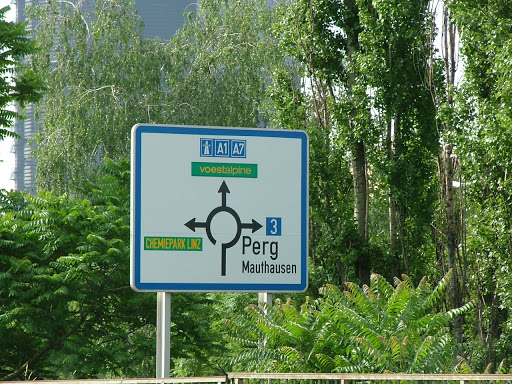
Given that I need to bike through two of Waidhofen's four traffic circles on my way to work everyday, it seemed appropriate to explain something about Europe's inexplicable affection for roudabouts, rotaries, and all things circular.  Waidhofen, with it's population of 12,000, has about one rotary for every 3,000 residents, while Providence has about one for every 175,000 residents, according to my memory.  France alone is apparently home to 50% of the world's traffic circles and the UK is home to so-called 'magic roundabouts,' where a large, two-way roundabout is composed of five or more smaller roundabouts.
 
Although they are, according to Wikipedia, safer for pedestrians and motorists than traditional intersecions, I remain skeptical of their advantages, at least for cyclists.  While most drivers in Austria appear to be aware that you need to yield to other autos in the circle, it is questionable whether they need to (or feel like they need to) yield to bicycles in the circle.  This has caused me much panic, but thankfully no close-calls.  And as a warning to American motorists abroad, God help you if you visit a country where people drive on the left and traffic circles flow clockwise, against all laws of nature. 

This complaints being registrered, I must admit that there are many advantages to traffic circles with regard to safety, efficiency, and aesthetics.  But as with many things distinctly European, I'm not sure that America is fully ready to adapt, despite the apparent advantages.  While adopting the metric system would mearly confuse people, building an abundance of traffic circles would probably result in America motorists plowing their mini-vans directly into the center island while speaking on the cell phone.

And, finally, the German word for these death traps is der Kreisverkehr, which fairly literally means 'traffic ring.'

10 October 2010

American Things That are More Common in Austria than in the US:

-McDonald's
-The King of Queens
-David Hasselhof's Musical Ambitions
-Grease
-'Hey Baby' by Bruce Channel from the Dirty Dancing soundtrack.
-Two and a Half Men (aka Mein Cooler Onkel Charlie)

And for those of you concerned about the red sludge catastrophe, Hungary is downstream along the Danube from Austria, so it will remain firmly Hungary's problem and not interfere with life in Waidhofen an der Ybbs.  And for today's vocabulary lesson, an environmental disaster is called Umweltkatastrophe.