Showing posts with label Going to all eight countries that border Austria. Show all posts

23 May 2011

Austria: A Year by the Numbers

Number of cows I've been chased
by on a bike: 2
A numerical summary of 243 days in Europe. 

Countries visited: 12 (Austria, Belgium, Czech Republic, Slovakia, Italy, Germany, Hungary, Greece, Slovenia, Croatia, England, Liechtenstein) 

Bordering countries visited: 7/8 (damn Switzerland!)

Austrian provinces visited: 8/9 (damn Carinthia!)

Degrees Celsius when I went swimming in the Danube: 5

Liters of beer consumed (est.): 170 (based on national average of 108.3)

Average number of ice cream cones per week: 3

Bikes ridden: 7
Reflective moments spent
overlooking Innsbruck: 1

  Metro systems used: 9

  Airplane trips: 2

  Train trips (est.): 86

  Trips to Vienna: 20

  Balls attended: 4

  Public restrooms begrudgingly paid  for: 1

  Number of hostels visited: 10

Number of nights spent in a hospital: 1

Number of nights not spent in a hospital: 242

Classes visited: 28

Lesson plans created: 90.4 MB

Students murdered: 0

Number of blog posts: 64

Books read: 11 German, 10 English

Free time during the week: lots

Number of chickens in my backyard: 3

Kilograms of stuff I'm allowed to bring back: 46

15 February 2011

Ljubljana - Not Just for Spelling Bees

After returning from Greece, I also made a short jaunt to Slovenia and Croatia, which thanks to the breakup of Yugoslavia twenty years ago means I get to add two countries to the list of places I've been (lifetime total up to fourteen, from just four one year ago).  Slovenia being one of Austria's neighbors, I also got one step closer to my arbitrary ambition of visiting all eight of its bordering countries (6/8=75%).  I look forward to being done with that list so I can cross it off my list of lists to cross off.  "Obsessive tendencies" remains on my list of character flaws to work on.   

Like many small cities in Austria,
Ljublana is almost to cute to function.
Well as for the trip, I had fantastic weather and a fantastic time.  In just one day in Slovenia I learned what the capital city is called (Ljubljana), how to pronounce it (loo-bee-lanja), and even a few words of Slovene (Hvala = hello).  An interesting note about the Slovenian language, which by the by is not the same as Croatian, is that its one of very few languages that have different declensions for the singular, plural, and dual forms of nouns.  Ordering beer in Slovenian is good practice: pivo = 1 beer, pivi = 2 beers, piva ≥ 3 beers. 

But outside of that boring stuff, Ljubljana is really purty (see right).

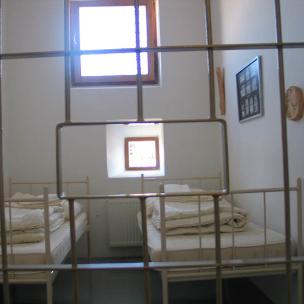
The hostel/former prison where I did
not stay.
Whilst there I met two Slovenians at a Slovenia v. Albania soccer match party who introduced me to a Ljublana hotspot they claimed was the world's most famous hostel - Hostel Celica - on the grounds of a former Yugoslavian prison.  This area of the city was like a city in itself, with >10 bars, people who appeared to live in said bars, other squatters, artist workshops, etc.

I also made friends with an itinerant Australian (they seem to be everywhere here), with whom I travelled to my next destination: Zagreb, the capital of Croatia.  He hitch-hiked while I shelled out for the train, but I think it goes without saying that I won that race.

Although Zagreb is a lovely city with plenty of culture, history, Dalmatian chard, bargain beer, nice architecture, and Eastern Bloc architecture, I think I would have preferred a trip to the Croatian coast, which I hear is absolutely lovely.  Another downside of my trip to the city was my narrow, harrowing escape from a 200 kuna ($40) fine for black riding on the Zagreb tram system.  Not speaking a word of Croatian helped.      

14 January 2011

The Budapest of Times


Rubbing his belly brings
good luck for dinner
The final stop on my winter holiday tour of Europe was Budapest - recently voted one of the 41 places to go in 2011 by the New York Times.  The number 41 seems arbitrary, but the summary of the city was spot on.  To summarize what we learned from our self-effacing tour guide Anna: 
One of the first stops on our tour was by the statue of a cheery, chubby policeman, whose bulging belly has been rubbed shiny by tourists wishing themselves good luck for their next meal.  The lawman's physique, Anna informed us, is typical of Hungarian men due the abundance of meat, lard, and paprika in the local cuisine.
 
We then moved on to Parliament - a beautiful neo-gothic building that looks remarkably similar to London's Westminster Palace.  The resemblence is no coincidence and in fact it was deliberately made a few inches longer than its more famous peer just to one-up English.  At this stop we learned about the workings of the Hungarian bureaucracy, whose employment rosters are more bloated than old Hungarian men.  Anna was not exaggerating, as every metro stop was staffed with 4-6 fairly indifferent controllers - one to check tickets, one to keep him company, and four to supervise.
Hungarian Parliament - Neo-Gothic Rip Off


We also visited St. Stephan's Basilica, an attractive church best known for hosting the severed hand of St. Stephan (his forearm and elbow are in Warsaw and Vienna, respectively).  Tourists can view the hand by just throwing half a euro in the severed-hand automat.  

Our final stop was a flea market in the city park, where homeless people on tarps sold stolen goods and collected refuse at an unbeatable price.  I was creeped out by many of the merchants - including the lady selling opened bags of breakfast cereals - but Maggie found a nice leather purse for 100 Forints (about 30 cents).  The flea market and the nearby Heroes' Square were overall quite representative of my impression of Hungary - half granduer, half filth, a touch of paprika and a real bargain.

11 January 2011

Mugs, Memories, and Munich

Maggie and I have returned to Waidhofen and my travels sadly are over.  Fortunately this means that I can devote more time to blogging.  Although I doubt I'll ever be able to describe all of the places I visited, I'll start with one of my favorites - Munich.

On a edutaining tour of the city, I learned that that everything in Munich is somehow related to beer consumption - from the famous Rathaus Glockenspiel (recently voted the second most overrated tourist attraction in Europe) to the city's oldest church (reconstructed after WWII with beer proceeds). Our tour guide also informed us of a beer-themed tour taking place that evening that promised to be less "edu" and more "taining."

Holding a Maß by the handle is only
appropriate for toasting.  In all other cases
it is taken as a sign of weakness.
At the beginning of the Munich beer tour I was very interested in learning more about Bavarian beer culture, although I must admit I became less and less diligent about collecting and retaining facts and even memories as we progressed from pub to pub.  One of the most interesting pieces of information that I did retain was the proper way to hold a giant one liter mug of beer, called a Maß (see right).  The handles attached to the mug are meant only to prevent finger-crushing collisions during a toast.  Outside of toasting, you're meant to hold these beers as you would a handle-less mug, with your hand directly on the glass.  Although this hand-to-glass contact might theoretically warm your beer, showing concern about your drink's temperature indicates to Bavarians that you are not drinking fast enough.   

This glorified pub crawl resulted in a number of great photos - some more compromising than others - on my mother's camera that I promise to post if she emails to me.

Another fact I retained from the beer tour is today's vocabulary offering - Reinheitsgebot.  It means "purity law" and it refers to a long-standing rule that all beer in Germany be made of only three ingredients - water, barley, and hops (and yeast, once it was discovered).  It is largely responsible for the lack of variety but abundance in quality of German beer, especially compared with the US.  Although it is no longer on the books due to whiny Dutch competitors, many German brewers still abide by it. Our beer guide informed us that this level of purity protects Bavarian beer consumers from hangovers - something that, through research, I have proven false.

17 December 2010

Holiday Itinerary

 Although I may not be able to update the old blog very frequently in the next three weeks, curious parties can always consult the following schedule to figure out where I am, what trouble I may be in, and which consulate to call in order to post my bail.

Train tracks with an unrealistic
amount of snow

December 18 - Vienna
December 19-21 - Genoa
December 22 - Vienna
December 23 - Waidhofen an der Ybbs
December 24 - Salzburg
December 25 - Salzburg
December 26 - Munich
December 27 - Munich
December 28-31 - Vienna
January 1 - Hamburg
January 2 - Hamburg
January 3-5 - Berlin
January 6 - Vienna
January 7 - Budapest
January 8 - Budapest
January 9 - Waidhofen an der Ybbs


And today's word, just for fun, is der Dudelsack - bagpipes.

14 December 2010

Braving Bratislava


Body heat from the mass of Slovakians
at the Christmas market raised the temperature
to a nearly bearable level.

The weekend before last I made a trip so brief that I nearly forgot to make a comment about it on the blog.  During a weekend visit to Vienna, I took advantage of the fact that European countries are packed onto their tiny continent like sovereign sardines in a multi-cultural tin can and decided to check out Bratislava - a completely different city with a completely different language just forty-five minutes away!   

Admittedly, the timing for my day trip was less than ideal as the temperature was creeping down toward zero (Fahrenheit!) most of the time we were out and about and it finally reached that frosty barrier after the sun went down around 3 o` clock.  The bitter cold surprised me as Bratislava and the comparatively tropical Vienna are at roughly the same latitude.  Seemingly, just crossing the former Iron Curtain reduces the temperature by ten degrees.  Nonetheless, I wanted to cross Slovakia off of my list of Austria's eight bordering countries and I'm happy I did so, even if my fingertips and nose were not appreciative of my efforts.

The so-called UFO Bridge is one of
the worst mistakes I`ve ever seen.
At its core, Bratislava is like a Mozart Ball candy with a minature marzipan center surrounded by unsweeted Soviet chocolate and served in a bowl of hideous architecture (left).  But to be fair, the city's tourist-laden center was truly beautiful and its charms were reminiscent of, but also unique from, those of its more-celebrated neighbor Vienna (fun fact: the two metropolises are the two of the world's closest capital cities).

Funny characters such as this smiling
sewer worker are spread around
the city center.
My friends and I spent less than four hours in the city including frequent thawing breaks, but we managed nonetheless to see all of the sites represented in the first twenty Google Image Search results.  Of these my favorites were the many bizarre characters cast in bronze to be found in and around Hviezdoslav Square (right).  We hustled from site to site and overall the trip had a very "we came, we saw, we photographed" feel.  The city would make an ideal day trip during nicer weather, but doesn't really warrant much more attention.


Today I've picked two of my new favorite wintery German words, both of which are in today's frontpage headlines in Austria.

Der Vorweichnachtsstress is the pre-Christmas stress familiar to many anxious Americans, less prevalent here.
Erfrieren means "to freeze to death," which felt like a real possibility in Bratislava.

21 November 2010

Out of Burgenland

I have just returned home from my budget jaunt to the province of Burgenland, where the hills are neglible and the wine flows as freely as tap water at an American casual dining restaurant.

Burgenland - a province known for its Zweigelt grape variety and its proximity to Hungary is perhaps not Austria's most enticing province, but it is nonetheless a crucial cog in my newfound goal of visiting all nine Austrian provinces (although not necessary for my other newfound goal of visiting all eight of Austria's neighboring nations, even Liechtenstein).*

But beyond fulfilling my trivial and arbitrary geographic ambitions, I also had a great time reconnecting with some terrific American friends I made at orientation in Graz back in September and visiting some truly minor tourist attractions.  First and foremost among them was an eerie monument constructed by Nazis in the village of Oberschützen that has since been rededicated as a memorial to the horrors of racism and autocracy.
Approaching the former Nazi monument, finding the weather appropriate
Earlier in our travels, we also found a hideous, concrete dormintory that looked like a Soviet's failed attempt at completing a tangram puzzle without all the pieces.  We used the building as a background to practice making trademark, non-smiling Eastern European facial expressions.

Inconsiderate tractor traffic made for a very representative Burgenland photo
 We then visited a mostly-Hungarian cemetery and did our best to conceal any hint of enjoying the journey.
Perfecting the Eastern European art of not smiling in photos
Yet, at the end of the day, we were all happy to be together.  We enjoyed hot pizza and then a few of us even explored the village nightlife - namely the smoky halls of Discostraße. 

Americans prefer smiling, even while being burned by hot grease

Unfortunately one site that I did not make it to was the nearby village of Klingenbach, where in 1989 the Iron Curtain first ripped and allowed an indirect passage to the West for East Germans.  Another aspiration of mine is to return and snap a photo of myself running across the once-fortified border, hopefully under the surveillance of a confused but harmless border guard. 

Fortunately my somber and rainy return to the weekly grind at school was cushioned by the auspicious arrival of Waidhofen's official town Christmas tree, which, in my absence, appears to have been installed by municipal Christmas fairies in the center of one of our many traffic circles.

And finally, today's German word takes its inspiration from the lowly-populated region where I spent my weekend - das Dorf means "the village."

*So far I have been to four of nine provinces (Vienna, Lower Austria, Styria, and Burgenland) and only one of eight neighbors (Czech Republic).

27 October 2010

A Prague Promenade

The Historic Charles Bridge (and other
less historic rivals) over the Vlatava River
After visiting Prague many Americans feel compelled to title their recollections and Facebook albums with those irresistable Czech puns ("Czech-ing in from Prague" or "Czech out how drunk I got in Eastern Europe," etc.).  To set my blog apart, I opted instead for some illogical alliteration that vaguely describes what I did this past weekend.

Last weekend was a national holiday here in Austria, so I did indeed cHecK out our neighbor to the north - the Czech Republic.  The capital city reminded me of Disney's Fantasyland, minus the exorbitant prices and basic rules of friendly interaction, transported behind the Iron Curtain along with blue jeans, Coca-Cola and the English language in 1993.

With my American tour guide (and friend of a friend) Jesse, I visited all of the obligatory tourist attractions, including the Charles Bridge (worthwhile), the John Lennon Wall (cool idea, lame art), and Prague Castle (site of the Second Defenestration of Prague, a tragic, yet hilarious occassion in European history).  Inside the castle, which is more of a district than a specific building, I found my favorite view of the city from the top of St. Vitus Cathedral.  It required a exhausting hike up an enormous spiral staircase from the 14th Century, when the average staircase climber was apparently about a foot shorter than I am.  My companions and I counted the number of stairs to the top and, although none of us was accurate, I was the closest with 234 out of 237 steps counted.

The Kafka Museum was terrifying.
We also visited the Kafka Musuem which was bizarre and unsettling, but truly "Kafkaesque" and certainly worth the 120 crowns ($5) admission fee.  Upon entering the museum's courtyard I was greeted with a statue of two grown men peeing into a small pond with functional penises that are adjustable by hand or by SMS.  I tried neither.  At the entrance to the museum, it was nearly impossible for me to actually buy a ticket because there appeared to be no employees, or at least none that were interested in selling tickets or interacting with guests.  When I eventually secured assitance, the cashier insisted that I pay in exact change and refused to break my 200 crown note, approximately equivalent to a $10 bill.  When I finally entered the museum, the images and artwork varied from baffling to nightmarish and the impressive views of the Vltava River were deliberately obscured with electrical tape.  All in all, I think Kafka would be proud.

As for souvenirs, I returned to Austria with a few postcards and several days worth of indigestion from greasy Czech street food.  Nonetheless, my trip was affordable, educational, and exciting and I heartily recommend Prague/Praha to any European tourist.    


In honor of Kafka's vision of the modern state as a terrifying bureaucratic hellhole (nowhere more accurate than Austria and Germany), my word of the day is Amtsdeutsch or "office German."  It means something along the lines of "legalese," but it refers to the indecipherable language used in German applications and forms.