Showing posts with label Transportation. Show all posts

28 June 2012

What's the Deal with Port Jervis??

Hello and greetings from Mt. Pocono, PA!  Today we road around 55 miles into town from Port Jervis, NY, with a grueling 6 mile climb to cap things off.  Just the same, I got into our host around 1 P.M., much earlier than usual, and had some time to blog.
The Historic Erie Turntable - shockingly devoid of tourists


Our last stop was in Port Jervis, NY, a formerly relevant train and canal hub, now scarcely populated by weirdos, squatters, and elderly folk who like to stand on their porches and glare at passers-by.  Here are some of the more unusual things I noticed about the town.

-The town's major attraction is the Historic Erie Turntable (seen right).  It is 120 feet of train track on top of a big lazy susan that used to be used to turn trains around.  It is one of the largest of its kind still around.  When I asked a local about it, she responded, "Oh you went and saw that did you?"  The other turntable in town was filled in and now serves as the foundation to a Burger King.

-I went to a bar called "Dad's Change of Pace" where I saw, among other things, a drag queen and a man's genitalia.

-The children in town made goat sounds at several of our female riders.

-A second-hand clothes store through me out because "nothing was for sale."

-The bike mechanic in town did not know how to make repairs to bikes. 

Overall Port Jervis felt like an episode of the Twilight Zone and we were sure to lock all our host's doors before calling it a night.

A gratuitous photo of me and the riders at our last build day.
What a good-looking bunch.

23 May 2011

Austria: A Year by the Numbers

Number of cows I've been chased
by on a bike: 2
A numerical summary of 243 days in Europe. 

Countries visited: 12 (Austria, Belgium, Czech Republic, Slovakia, Italy, Germany, Hungary, Greece, Slovenia, Croatia, England, Liechtenstein) 

Bordering countries visited: 7/8 (damn Switzerland!)

Austrian provinces visited: 8/9 (damn Carinthia!)

Degrees Celsius when I went swimming in the Danube: 5

Liters of beer consumed (est.): 170 (based on national average of 108.3)

Average number of ice cream cones per week: 3

Bikes ridden: 7
Reflective moments spent
overlooking Innsbruck: 1

  Metro systems used: 9

  Airplane trips: 2

  Train trips (est.): 86

  Trips to Vienna: 20

  Balls attended: 4

  Public restrooms begrudgingly paid  for: 1

  Number of hostels visited: 10

Number of nights spent in a hospital: 1

Number of nights not spent in a hospital: 242

Classes visited: 28

Lesson plans created: 90.4 MB

Students murdered: 0

Number of blog posts: 64

Books read: 11 German, 10 English

Free time during the week: lots

Number of chickens in my backyard: 3

Kilograms of stuff I'm allowed to bring back: 46

21 March 2011

This Old House

My Coordinates
During a long chat over Gugelhupf with my landlady yesterday, I got two good earfuls of stories about the house where I live in Waidhofen - some funny, some tragic, some touching.  Omitting the boring parts:

The house was built in 1905 by some guy named Leopold Fallmann, whose name is still on the house.  It's been in my landlady's family since 1934, at which point in time it housed four entire families (it now houses one American, one Austrian, and one Hungarian, whose German is about as good as the cat's).  During this time one family lived in my two-room apartment and another in the dining room across the hall.  They apparently hated each other so much that they often threw their buckets of human waste against each others' doors.  There was no plumbing.

During the war a Nazi tank ran out of gas directly in front the house and later exploded.  It burned for three days and blew out all of the windows on that side of the building.  My landlady's father later stole a wheel from the tank and used it for his rope-making apartus, while the local children used the cannon as a balance beam.  Another time a Nazi drove by the house and screamed to the balcony, "Ist hier Klagenfurt?"  To his dismay Klagenfurt is, and was, about 95 miles away.

After the war, retreating Austrian soldiers marched along Weyerer Straße, a half a block from my house, on their way to Vienna. They were, apparently, not in an especially good mood.

During parts of the occupation, which lasted from 1945 to 1955, the house quartered a Soviet soldier.  He took up more than his fair share of the living space, but was quite nice to the children.  He taught them Russian words and gave them lollipops, which they had never seen before and did not know what to do with.

Things have quieted down since 1955, although in the past year two hens were eaten by a badger and one rooster drowned after being chased into a large puddle by n'er do well neighborhood cats.  Turns out they're as bad at swimming as they are at flying.


And for anyone who was curious, the answer to the fake headline quiz was "Foreigners Seen J-Walking: Police Take Action."  This is for the best, as the foreigner in question would almostly certainly have been me.

15 February 2011

Ljubljana - Not Just for Spelling Bees

After returning from Greece, I also made a short jaunt to Slovenia and Croatia, which thanks to the breakup of Yugoslavia twenty years ago means I get to add two countries to the list of places I've been (lifetime total up to fourteen, from just four one year ago).  Slovenia being one of Austria's neighbors, I also got one step closer to my arbitrary ambition of visiting all eight of its bordering countries (6/8=75%).  I look forward to being done with that list so I can cross it off my list of lists to cross off.  "Obsessive tendencies" remains on my list of character flaws to work on.   

Like many small cities in Austria,
Ljublana is almost to cute to function.
Well as for the trip, I had fantastic weather and a fantastic time.  In just one day in Slovenia I learned what the capital city is called (Ljubljana), how to pronounce it (loo-bee-lanja), and even a few words of Slovene (Hvala = hello).  An interesting note about the Slovenian language, which by the by is not the same as Croatian, is that its one of very few languages that have different declensions for the singular, plural, and dual forms of nouns.  Ordering beer in Slovenian is good practice: pivo = 1 beer, pivi = 2 beers, piva ≥ 3 beers. 

But outside of that boring stuff, Ljubljana is really purty (see right).

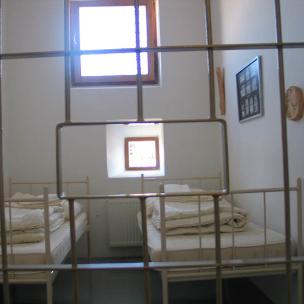
The hostel/former prison where I did
not stay.
Whilst there I met two Slovenians at a Slovenia v. Albania soccer match party who introduced me to a Ljublana hotspot they claimed was the world's most famous hostel - Hostel Celica - on the grounds of a former Yugoslavian prison.  This area of the city was like a city in itself, with >10 bars, people who appeared to live in said bars, other squatters, artist workshops, etc.

I also made friends with an itinerant Australian (they seem to be everywhere here), with whom I travelled to my next destination: Zagreb, the capital of Croatia.  He hitch-hiked while I shelled out for the train, but I think it goes without saying that I won that race.

Although Zagreb is a lovely city with plenty of culture, history, Dalmatian chard, bargain beer, nice architecture, and Eastern Bloc architecture, I think I would have preferred a trip to the Croatian coast, which I hear is absolutely lovely.  Another downside of my trip to the city was my narrow, harrowing escape from a 200 kuna ($40) fine for black riding on the Zagreb tram system.  Not speaking a word of Croatian helped.      

13 February 2011

Greece is the Word

Birthplace of the  Modern Olympics.
Rocky-style workouts were sadly
forbidden by stadium edict.

Semesterferien (term break) is over and I have just returned from my trips to Croatia, Slovenia, and, my favorite, Greece.  Outside of the public restrooms - where a mysterious and malevolent injunction against flushing toilet paper down the commode leaves you with a rather unpleasant alternative - I found Greece to be a tremendously agreeable place.  In fact, I think February was the perfect time to visit, as the weather was warm enough to wade in the Aegean, but cool enough that the cafes did not necessarily double as Turkish baths.  Plus it was even possible to wander about the Acropolis without swimming through a sea of fanny-packed tourists with substandard walking skills.

Acropolis with the calorie-burning
Lycabettus Hill in the background.

During my stay in Athens I hiked up Lycabettus Hill, met with hunger-striking refugees, and ate about a kilo of feta - atop salads, in gyros, on crepes, and straight out of the package.  I enjoyed other culinary delights, including olives, ouzo, tyropita, and Mythos beer.  Although I highly recommend sampling all of these things, I caution that the thick Greek coffee requires an unusual amount of chewing, which makes sense as it is often all that the Greeks have for breakfast.  


I suspect that Greek coffee may be
responsible for the short stature of Greek men,
which was quite obvious from my
conspicuous perch at 1.93 meters.
I left Athens one day to visit Sounion, a remarkably beautiful cliffside that hosts the ruins of a temple to Poseidon that was once tagged by the English poet Lord Byron in a vandalistic fit of enthusiam.  Later that day I also got to sit in on college application interviews with two Greek-Americans aspiring to the class of 2015 thanks to my host and fellow Brown alum George.  Then, sadly, I had to leave Greece with just a jar of honey and a bottle of olive oil to remind me of my stay in Hellas.

Fortunately, the Athens metro workers held off their inevitable daily strike until after I had reached the airport.  The Greeks, it turns out, really like their strikes. 


25 January 2011

No Matter Where You Go, Some People Dress Like Fools...

Schematic Diagram of a
Krocha
Although America may be the place for misguided and foolish youth cultures, a bizarre minority specimen of Austrian teenager is worthy of comment.

They are called die Krocha* and their preferred habitat is the disco.  They are reminiscent in attitude of American "bros," especially because of their lust for clubbing and their taste for Ed Hardy wear (Keine Party ohne Ed Hardy, as they say). 

Three Krocha in their
natural environment
This resemblence to more familiar youth cultures does not extend to other aspects of their attire, many of which are distinctly European or, more accurately, "Eurotrash."  They favor white Adidas sneakers, extremely tight pants, and large key loops for wrapping around their right leg.  They sport finely manicured eyebrows, spray-on tans, and stiffly gelled hair, perhaps as protection from concussions received while dancing.  They also have an insatiable appetite for Palestinian checkered scarves (called Palästinensertuch in German), which they wear as mere accessories, with extreme indifference to potential political meaning.  

They have a language of their own and particularly enjoy the word Oida, which is rougly equivalent to "dude" or "man."  It is sometimes also used without context just to add some flavor to their almost certainly vacuous sentences.  Like popular American TV Chef Emeril Lagasse, they also like to use the word Bam frequently in order to demonstrate their extreme enthusiasm for another's enviable neon-colored baseball cap or impressive dance skills**.  The rest of their vocabulary is a mixture of Viennese (Wienerisch) and various migrant languages.

An urban Austrian phenomenon - I have encountered very few Krocha out here in the countryside and I don't have any as students.  According to German Wikipedia, only 1.7% of 11-29 year olds in Austria identify as Krocha, although I'm not sure how Wikipedia could have gotten this information and I doubt that Krocha is a checkable box in many surveys or censuses.  I've read reports that this style is fading into obscurity (thankfully, according to most accounts), but in my experience they remain common U-Bahn fixtures.  I have rarely seen them in daylight, which they seem to detest despite their remarkable tans.

*I think this word stems originally from the Wienerisch word for the Hochdeutsch hineinkrachen, which means "to encroach."  The word was Austria's second-place Word of the Year 2008, behind Lebensmensch.
**The "krochn" dance style goes best with music from the album krocha traxx vol. 1, available from Universal Music.

13 October 2010

Traffic Circles

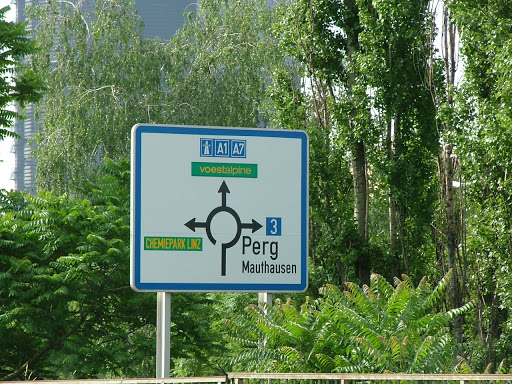
Given that I need to bike through two of Waidhofen's four traffic circles on my way to work everyday, it seemed appropriate to explain something about Europe's inexplicable affection for roudabouts, rotaries, and all things circular.  Waidhofen, with it's population of 12,000, has about one rotary for every 3,000 residents, while Providence has about one for every 175,000 residents, according to my memory.  France alone is apparently home to 50% of the world's traffic circles and the UK is home to so-called 'magic roundabouts,' where a large, two-way roundabout is composed of five or more smaller roundabouts.
 
Although they are, according to Wikipedia, safer for pedestrians and motorists than traditional intersecions, I remain skeptical of their advantages, at least for cyclists.  While most drivers in Austria appear to be aware that you need to yield to other autos in the circle, it is questionable whether they need to (or feel like they need to) yield to bicycles in the circle.  This has caused me much panic, but thankfully no close-calls.  And as a warning to American motorists abroad, God help you if you visit a country where people drive on the left and traffic circles flow clockwise, against all laws of nature. 

This complaints being registrered, I must admit that there are many advantages to traffic circles with regard to safety, efficiency, and aesthetics.  But as with many things distinctly European, I'm not sure that America is fully ready to adapt, despite the apparent advantages.  While adopting the metric system would mearly confuse people, building an abundance of traffic circles would probably result in America motorists plowing their mini-vans directly into the center island while speaking on the cell phone.

And, finally, the German word for these death traps is der Kreisverkehr, which fairly literally means 'traffic ring.'

01 October 2010

Wien-Graz-Wien

Hello and greetings from Vienna. I have completed my orientation in Graz and returned to the capital city for the weekend with new Fulbright friends before heading to my new home in Waidhofen.

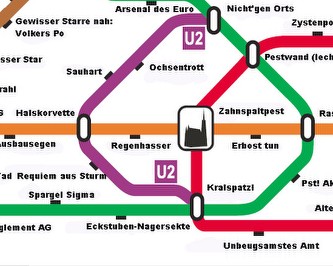
One of my favorite things about Wien is, without surprise, the underground system. It's very logical, except that the lines are numbered 1, 2, 3, 4, and 6. There is no obvious explanation about what happened to U5, but rumors abound. The convenient (but scary) thing about the system is that there are no turnstiles like there are in the States. Instead, you can just hop on the train with or without a ticket, although you run the risk of getting a major fine if caught by a plain-clothes train officer (it's jokingly called "getting controlled").

The German word for riding illegally on public transit (specific I know) is Schwarzfahren, which literally means "black riding." As a prefix, black often means illegal, as in the "black market."