Showing posts with label Beer. Show all posts

23 May 2011

Austria: A Year by the Numbers

Number of cows I've been chased
by on a bike: 2
A numerical summary of 243 days in Europe. 

Countries visited: 12 (Austria, Belgium, Czech Republic, Slovakia, Italy, Germany, Hungary, Greece, Slovenia, Croatia, England, Liechtenstein) 

Bordering countries visited: 7/8 (damn Switzerland!)

Austrian provinces visited: 8/9 (damn Carinthia!)

Degrees Celsius when I went swimming in the Danube: 5

Liters of beer consumed (est.): 170 (based on national average of 108.3)

Average number of ice cream cones per week: 3

Bikes ridden: 7
Reflective moments spent
overlooking Innsbruck: 1

  Metro systems used: 9

  Airplane trips: 2

  Train trips (est.): 86

  Trips to Vienna: 20

  Balls attended: 4

  Public restrooms begrudgingly paid  for: 1

  Number of hostels visited: 10

Number of nights spent in a hospital: 1

Number of nights not spent in a hospital: 242

Classes visited: 28

Lesson plans created: 90.4 MB

Students murdered: 0

Number of blog posts: 64

Books read: 11 German, 10 English

Free time during the week: lots

Number of chickens in my backyard: 3

Kilograms of stuff I'm allowed to bring back: 46

09 April 2011

Things that I collect

Living in Europe and having too much free time has inspired me to pick up two not-so-glamorous hobbies: keeping a blog and collecting things.  To combine my two passions, a list:

-Austrian beer coasters.  Anyone that can find me a Schwechater, Zwettler, or a Puntigamer would complete my collection and be my hero!  Although most all Austrian beers taste the same, their coasters have cool designs and slogans.  My favorites are "das bierige Bier" ("the beery beer") and "Ein Glas heller Freude" ("a glass of delightful joy").  Also, anyone with a suggestion for a lovely coaster art project please speak up!

-Currencies.  The euro really ruined my opportunity to collect currencies.  I've only got four so far, not counting the ten-dollar bill I've been carrying uselessly since September.

-Metro tickets.  So far I've got Vienna, Prague, Munich, Hamburg, Berlin, Budapest, Athens, and Zagreb.

One of the only German hairdresser
puns I've ever seen.  It's a play on the
words for "progress" and "cut."
-Animal stickers from Billa, initially intended for children to stick in a sticker book.  If anyone has the bottom-third of the giraffe sticker, I'm willing to trade.

-Postcards.  I guess that one's not that weird.  Send me some more.

-Photos of hairdressers with punny names like "Curl Up & Dye," "British Hairways," or "Hair Force One."


An unrelated word-of-the-day, but one which I find amusing, if a little morbid, is das Leichenschauhaus.  It means "morgue," but in little German chunks it means something more like "dead body looking-at house."

31 March 2011

America vs. Europe - Grocery Store Edition

Dogs are theoretically forbidden
from Austrian grocery stores.
A recent trip inspired me to point out some of the more comical differences:

-Whereas American supermarkets are known for hiding the milk in the back of the store to make you walk past all of their other offerings, Austrian grocery stores are more likely to apply this principle to beer and wine.

-American grocery stores usually provide free and limitless shopping carts, while Austrian stores usually require a small deposit for each cart, presumably to discourage theft, although I think that anyone who really wants a shopping cart is willing to pay €.50 for it.  (Tip: Austrian shopping cart dispensers also take American coins!)

-America: 168 open hours per week. Austria: 72.  See: Gemütlichkeit.

-Produce in Austrian grocery stores often needs to weighed and labelled by the customer - a task that I think many Americans would be incapable of.  I myself have gotten majorly scolded for forgetting.

-Supermarkets in America often provide customers with free bagging service.  The lack of such a service in Austria has surely destroyed a potential job market for teenagers, ex-cons, retirees and other qualification-impaired individuals.

-Peanut butter here is 100% more expensive and you get weird looks for buying it.


And for today's German lesson, I'd like to point out how amusing it is that the names of German meals can also be used as verbs, which is certainly not the case in English.  Thus, das Frühstück is "breakfast" and frühstücken is "to breakfast."

15 February 2011

Ljubljana - Not Just for Spelling Bees

After returning from Greece, I also made a short jaunt to Slovenia and Croatia, which thanks to the breakup of Yugoslavia twenty years ago means I get to add two countries to the list of places I've been (lifetime total up to fourteen, from just four one year ago).  Slovenia being one of Austria's neighbors, I also got one step closer to my arbitrary ambition of visiting all eight of its bordering countries (6/8=75%).  I look forward to being done with that list so I can cross it off my list of lists to cross off.  "Obsessive tendencies" remains on my list of character flaws to work on.   

Like many small cities in Austria,
Ljublana is almost to cute to function.
Well as for the trip, I had fantastic weather and a fantastic time.  In just one day in Slovenia I learned what the capital city is called (Ljubljana), how to pronounce it (loo-bee-lanja), and even a few words of Slovene (Hvala = hello).  An interesting note about the Slovenian language, which by the by is not the same as Croatian, is that its one of very few languages that have different declensions for the singular, plural, and dual forms of nouns.  Ordering beer in Slovenian is good practice: pivo = 1 beer, pivi = 2 beers, piva ≥ 3 beers. 

But outside of that boring stuff, Ljubljana is really purty (see right).

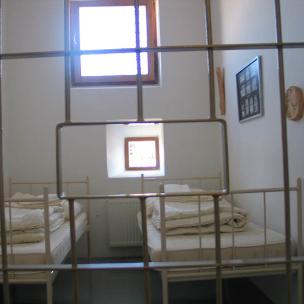
The hostel/former prison where I did
not stay.
Whilst there I met two Slovenians at a Slovenia v. Albania soccer match party who introduced me to a Ljublana hotspot they claimed was the world's most famous hostel - Hostel Celica - on the grounds of a former Yugoslavian prison.  This area of the city was like a city in itself, with >10 bars, people who appeared to live in said bars, other squatters, artist workshops, etc.

I also made friends with an itinerant Australian (they seem to be everywhere here), with whom I travelled to my next destination: Zagreb, the capital of Croatia.  He hitch-hiked while I shelled out for the train, but I think it goes without saying that I won that race.

Although Zagreb is a lovely city with plenty of culture, history, Dalmatian chard, bargain beer, nice architecture, and Eastern Bloc architecture, I think I would have preferred a trip to the Croatian coast, which I hear is absolutely lovely.  Another downside of my trip to the city was my narrow, harrowing escape from a 200 kuna ($40) fine for black riding on the Zagreb tram system.  Not speaking a word of Croatian helped.      

13 February 2011

Greece is the Word

Birthplace of the  Modern Olympics.
Rocky-style workouts were sadly
forbidden by stadium edict.

Semesterferien (term break) is over and I have just returned from my trips to Croatia, Slovenia, and, my favorite, Greece.  Outside of the public restrooms - where a mysterious and malevolent injunction against flushing toilet paper down the commode leaves you with a rather unpleasant alternative - I found Greece to be a tremendously agreeable place.  In fact, I think February was the perfect time to visit, as the weather was warm enough to wade in the Aegean, but cool enough that the cafes did not necessarily double as Turkish baths.  Plus it was even possible to wander about the Acropolis without swimming through a sea of fanny-packed tourists with substandard walking skills.

Acropolis with the calorie-burning
Lycabettus Hill in the background.

During my stay in Athens I hiked up Lycabettus Hill, met with hunger-striking refugees, and ate about a kilo of feta - atop salads, in gyros, on crepes, and straight out of the package.  I enjoyed other culinary delights, including olives, ouzo, tyropita, and Mythos beer.  Although I highly recommend sampling all of these things, I caution that the thick Greek coffee requires an unusual amount of chewing, which makes sense as it is often all that the Greeks have for breakfast.  


I suspect that Greek coffee may be
responsible for the short stature of Greek men,
which was quite obvious from my
conspicuous perch at 1.93 meters.
I left Athens one day to visit Sounion, a remarkably beautiful cliffside that hosts the ruins of a temple to Poseidon that was once tagged by the English poet Lord Byron in a vandalistic fit of enthusiam.  Later that day I also got to sit in on college application interviews with two Greek-Americans aspiring to the class of 2015 thanks to my host and fellow Brown alum George.  Then, sadly, I had to leave Greece with just a jar of honey and a bottle of olive oil to remind me of my stay in Hellas.

Fortunately, the Athens metro workers held off their inevitable daily strike until after I had reached the airport.  The Greeks, it turns out, really like their strikes. 


01 February 2011

Very Austrian Things That I've Done So Far

Since arriving in September, I've...

-Waltzed to a live performance of the Baywatch Theme Song.  (The blatant lack of appropriate time signature does not deter Austrians from waltzing.)
Alpenhütte party atop nearby Prochenberg
-Enjoyed three-hour lunch breaks.
-Screamed at a stranger for failing to stand right, walk left on an U-Bahn escalator in Vienna.  I'm not normally this unfriendly, but I could not miss that train. 
-Hiked up a mountain, discovered an Alpenhütte (mountain hut) party, drank a beer, hiked back.
-Hiked a different mountain with Maggie, discovered a Gasthaus (guesthouse/inn), drank a beer, hiked back.  We also played a wooden glockenspiel on said mountain.
-Judged people for mentioning The Sound of Music.
-Demanded, with near immediate success, that a DJ play the #1 International Superhit Barbara Streisand.
-Bagged my own groceries every time.
-AND stayed in one cafe for a period of time so lengthy that I would have almost certainly been suspected of homelessness in the US.

11 January 2011

Mugs, Memories, and Munich

Maggie and I have returned to Waidhofen and my travels sadly are over.  Fortunately this means that I can devote more time to blogging.  Although I doubt I'll ever be able to describe all of the places I visited, I'll start with one of my favorites - Munich.

On a edutaining tour of the city, I learned that that everything in Munich is somehow related to beer consumption - from the famous Rathaus Glockenspiel (recently voted the second most overrated tourist attraction in Europe) to the city's oldest church (reconstructed after WWII with beer proceeds). Our tour guide also informed us of a beer-themed tour taking place that evening that promised to be less "edu" and more "taining."

Holding a Maß by the handle is only
appropriate for toasting.  In all other cases
it is taken as a sign of weakness.
At the beginning of the Munich beer tour I was very interested in learning more about Bavarian beer culture, although I must admit I became less and less diligent about collecting and retaining facts and even memories as we progressed from pub to pub.  One of the most interesting pieces of information that I did retain was the proper way to hold a giant one liter mug of beer, called a Maß (see right).  The handles attached to the mug are meant only to prevent finger-crushing collisions during a toast.  Outside of toasting, you're meant to hold these beers as you would a handle-less mug, with your hand directly on the glass.  Although this hand-to-glass contact might theoretically warm your beer, showing concern about your drink's temperature indicates to Bavarians that you are not drinking fast enough.   

This glorified pub crawl resulted in a number of great photos - some more compromising than others - on my mother's camera that I promise to post if she emails to me.

Another fact I retained from the beer tour is today's vocabulary offering - Reinheitsgebot.  It means "purity law" and it refers to a long-standing rule that all beer in Germany be made of only three ingredients - water, barley, and hops (and yeast, once it was discovered).  It is largely responsible for the lack of variety but abundance in quality of German beer, especially compared with the US.  Although it is no longer on the books due to whiny Dutch competitors, many German brewers still abide by it. Our beer guide informed us that this level of purity protects Bavarian beer consumers from hangovers - something that, through research, I have proven false.