19 October 2010

Other Misunderstandings

The number funny of misinterpretations I encounter in Austria grows daily.  The latest is related to the environmental crisis in Hungary (left), which is called Giftschlamm by German-language newspapers.  When I first heard this word I knew that "gift" meant "poison" (interesting?), and I assumed that "schlamm" was equivalent to the English "slam," meaning that the red sludge in Hungary was a "Poison Slam."  Although Poison Slam would be a great name for a SNES video game or death metal band, "Giftschlamm" actually means dangerous mud or sludge, as I was recently disappointed to find out.

Another example is related to emergency exits, which are called Notausgang in German.  When I first arrived, I knew that "ausgang" meant "exit," but not knowing what the prefix "not" really meant, I thought signs for a "Notausgang" meant that a given door was not an exit.  This could have been a very unfortunate misunderstanding indeed.

Luckilzy, European exit signs are more universal than American ones in that they use no written language and therefore they are obvious to illiterates, kindergarteners, and even intelligent animals.  Plus they're green, which may keep people calm during an actual emergency.  Slate has a lengthy and comprehensive article on this topic (here), but beware its length and comprehensivity.  

As a final note, I'm headed to Prague for the weekend to celebrate my extended "Austria Day" holiday in another country.  I'll be back on in Waidhofen on Tuesday.

16 October 2010

On Mistranlsations

Although I usually teach just the 14-18 year old crowd, yesterday I had the opportunity to visit a 1st Form (10-11 year olds) classroom, where the students are in their first year of English.  My teacher and I presented them with the taxing activity of describing cartoon pirates, in writing, with the useful English expressions "he's got a..." and "he hasn't got a..." 

Many of the youngsters shied away from my towering American height, but many more tried to impress me with fancy English sentences about their cartoon pirates.  One particularly ambitious lad proudly presented me his complicated, multiword sentence, "In his face is all big."  I felt that something had been lost in translation, so I asked what he was trying to say in German, to which he responded, "In seinem Gesicht ist alles groß," which means the same thing, fairly literally.  Then I thought maybe the problem was not the English language, but rather with this peculiar's idea of describing faces.  I was surprised to find out later that this is an appropriate way say in German that somebody has a large nose and ears.

And this is sadly why most things cannot be translated literally, why languages are difficult to learn, and why Google Translate cannot do your homework (yet).  And today's German word is der Übersetzsungfehler, or "mistranslation."  The fact that two of my German words of the day were types of mistakes (der Tippfehler)  be a reflection of how flawlessly I've been conducting my affairs....

13 October 2010

Traffic Circles

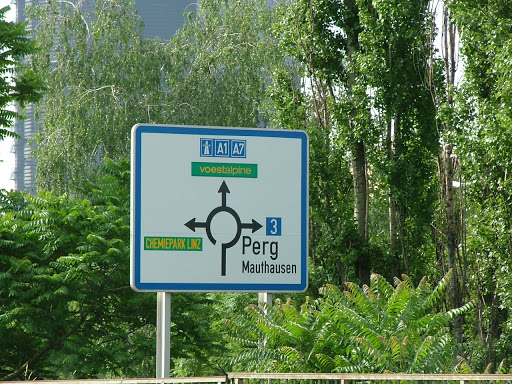
Given that I need to bike through two of Waidhofen's four traffic circles on my way to work everyday, it seemed appropriate to explain something about Europe's inexplicable affection for roudabouts, rotaries, and all things circular.  Waidhofen, with it's population of 12,000, has about one rotary for every 3,000 residents, while Providence has about one for every 175,000 residents, according to my memory.  France alone is apparently home to 50% of the world's traffic circles and the UK is home to so-called 'magic roundabouts,' where a large, two-way roundabout is composed of five or more smaller roundabouts.
 
Although they are, according to Wikipedia, safer for pedestrians and motorists than traditional intersecions, I remain skeptical of their advantages, at least for cyclists.  While most drivers in Austria appear to be aware that you need to yield to other autos in the circle, it is questionable whether they need to (or feel like they need to) yield to bicycles in the circle.  This has caused me much panic, but thankfully no close-calls.  And as a warning to American motorists abroad, God help you if you visit a country where people drive on the left and traffic circles flow clockwise, against all laws of nature. 

This complaints being registrered, I must admit that there are many advantages to traffic circles with regard to safety, efficiency, and aesthetics.  But as with many things distinctly European, I'm not sure that America is fully ready to adapt, despite the apparent advantages.  While adopting the metric system would mearly confuse people, building an abundance of traffic circles would probably result in America motorists plowing their mini-vans directly into the center island while speaking on the cell phone.

And, finally, the German word for these death traps is der Kreisverkehr, which fairly literally means 'traffic ring.'

10 October 2010

American Things That are More Common in Austria than in the US:

-McDonald's
-The King of Queens
-David Hasselhof's Musical Ambitions
-Grease
-'Hey Baby' by Bruce Channel from the Dirty Dancing soundtrack.
-Two and a Half Men (aka Mein Cooler Onkel Charlie)

And for those of you concerned about the red sludge catastrophe, Hungary is downstream along the Danube from Austria, so it will remain firmly Hungary's problem and not interfere with life in Waidhofen an der Ybbs.  And for today's vocabulary lesson, an environmental disaster is called Umweltkatastrophe.

07 October 2010

Meine Neue Wohnung

Wohnung, apartment.  My new address, for those who wish to send mail, is Scott Middleton, Teichgasse 7, 3340 Waidhofen an der Ybbs, Niederösterreich, Austria.

Yesterday I moved to a permanent flat that I'm renting from an old lady who runs an antique store in downtown Waidhofen.  It has the reassuring smell of a summer cottage that hasn't been rented since the fall of the Berlin Wall, plus there are chickens in the backyard that I suspect may produce free eggs for me.  The rent is only €230 per month, which I'm very happy about.

Also yesterday I picked up two boxes of goodies that were left for me by my predecessor in the schools.  The boxes included plates, bowls, pans, a portable DVD player, The Princess Bride in German, condoms, two cameras, tea, spices, and a bike.*  Christmas (Weihnachtsfest) came early.

*To be clear, the bike was not in the boxes, but rather came with them. 

05 October 2010

Nothing strange about this post...

Congratulations on finding the secret blog post! Although this post claims to have been written on 5 October 2010, it was in fact written on 9 April 2011.

You must be truly committed to my blog to have found this.  I appreciate your devotion and I encourage to leave a comment below to brag about your attention to detail and your love of my blog.

As a reward, here is one of my favorite jokes:

Q: How many mice does it take to screw in a lightbulb?
A: Two, but how did they get in there?

To reward you further, he is an irrelevant, but excellent German word: die Blutschande - one German word for incest that more literally means "blood shame."

01 October 2010

Wien-Graz-Wien

Hello and greetings from Vienna. I have completed my orientation in Graz and returned to the capital city for the weekend with new Fulbright friends before heading to my new home in Waidhofen.

One of my favorite things about Wien is, without surprise, the underground system. It's very logical, except that the lines are numbered 1, 2, 3, 4, and 6. There is no obvious explanation about what happened to U5, but rumors abound. The convenient (but scary) thing about the system is that there are no turnstiles like there are in the States. Instead, you can just hop on the train with or without a ticket, although you run the risk of getting a major fine if caught by a plain-clothes train officer (it's jokingly called "getting controlled").

The German word for riding illegally on public transit (specific I know) is Schwarzfahren, which literally means "black riding." As a prefix, black often means illegal, as in the "black market."