14 November 2010

Who is Krampus?

Krampus - the Publically-Sanctioned Child-Scarer
The handsome gentleman seen to the right is named Krampus, the beloved descendant of a terrifying, pre-Christian Alpine tradition.  I was introduced to him last night when an Austrian friend from Waidhofen generously offered to take me to a Perchtenlauf in the nearby town of Ybbsitz.  Having no idea what a Perchtenlauf might be, and feeling too embarrassed to ask, I gladly accepted the invitation. 

As it turns out, a Perchtenlauf is a traditional parade held annually in many Austrian towns during the Christmas season.  (NOTE: Although it is questionable whether the Christmas season has already properly started, I have noticed that without Thanksgiving as a semi-official starting line, Austrians have a harder time agreeing upon exactly when it is permissible to start celebrating and shopping like maniacs.)  Perchtenlauf is equivalent, perhaps, to America's Macy's Day Parade, but without Matt Lauer or the famously large (and sometimes deadly) balloons.  Instead, a traditional Perchtenlauf features packs of young men dressed as the character Krampus. 

These young men, who are active members of large Krampus clubs, dress up with horns and masks made of wood and sheep skin and wield torches, flares, and clubs as they march through the streets terryfing women and children.  Thankfully, no one is ever actually burned, bitten, or stabbed, and everyone has a good time.  Ample quantities of spiced cider increase the excitement and, along with all the flames, keep the crowd warm. (Click here for a cool Krampus-themed holiday drink recipe)

The Perchtenlauf in Ybbsitz came early in the season, as the busiest day of the year for Krampus is St. Nikolaus Day, the Sixth of December.  On the eve of this holiday, St. Nikolaus/Nicholas - essentially Santa Claus, but dressed more like the Pope (left) - brings presents to well-behaved children, but dispatches the gruesome Krampus to naughty children, whom are then dragged into the pits of hell.  When I asked my Austrian companions to clarify the relationship between Krampus and St. Nikolaus, they explained that they are neither friends nor enemies, but rather co-workers, with St. Nikolaus holding the dominant, upper-management position.

Outside of Perchtenlauf and St. Nikolaus Day, the Krampus tradition is carried out on weekend nights by young men who use the opportunity to harrass women with large cowbells, rusty chains, and home-made whips.  The practice is especially popular at nightclubs and in the province of Styria.  Although this tradition would certainly lead to legal action in the United States, it's all in good fun and even the children really seem to love it.

For some great news footage of one of last year's larger Perchtenlaufs, click here.

11 November 2010

Sample Dialogue

Part of my job is to educate Austrians about the USA and to dispel stereotypes about Americans.  Sometimes I perpetuate them by mistake.  Yesterday, while answering questions in class:

Student: Is it true that all Americans are obese?
Scott: No, not really... except in the South.


der Heuchler - a hypocrit

09 November 2010

Things I See While Jogging

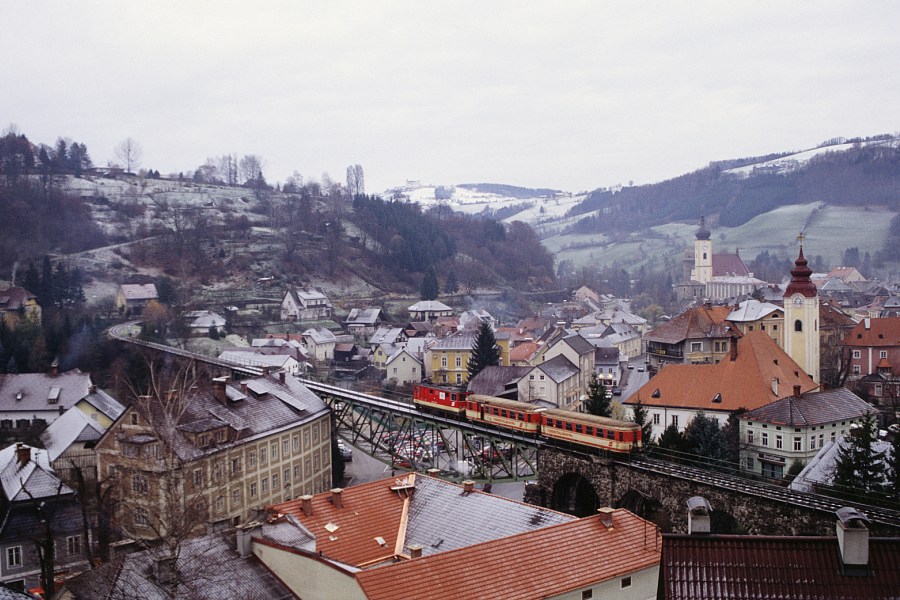
So I've finally settled on a fixed course that I use just about every day to go running.  It's about 6 or 7 kilometers long and it offers a number of truly amusing sites.  Some are delightfully Austrian and some are just charming in their own right.  I usually run by:


Waidhofen's Cool Viaduct

-A self-service schnapps bar
-A fresh milk automat (milk appears to come directly from cows)
-Two cemetaries, one of which is adjacent to a retirement home
-A cool viaduct
-A restaurant that advertises "Five Euro Schnitzel Wednesdays"
-Three traffic circles
-A full-time castle, part-time nightclub
-A mountain
-Packs of older Austrians who seem to love their Nordic walking sticks, but also seem to ingore proper Nordic walking technique


I question the necessity of using poles.
And as a follow-up to my last post, the castle club night was a fun and successful adventure.  I have collected some real, live Austrian friends, one of whom taught me my new favorite German word and today's offering - das Kuddelmuddel.  It's an unbelievably adorable word for a mess or a mix-up, especially one that a child would create. 


04 November 2010

Attempts at Socializing

Unsuspecting castle becomes target of vicious Austrian club scene
Last weekend in Vienna I was fortunate enough to meet someone my age who comes from my adopted hometown of Waidhofen an der Ybbs.  Like most other Waidhofners (people from Waidhofen) between the ages of 18 and 45, she no longer lives in Waidhofen, but she was generous enough to offer to take me out this Friday and introduce me to other young adults this coming weekend.  For the record, I remain skeptical that there are other young adults in Waidhofen.

At her suggestion we're going to a club night in - naturally - a fourteenth-century castle.

Aside from the terrifying prospect of running into my students, I'm looking forward to the adventure.  Although I've gone out in Vienna and Prague, this will be my first attempt at my new Lieblingsdorf (favorite village).  With any luck the club will bear little resemblence to the most embarrassing place in Providence.

As a real, authentic German document, I've included a description from the club's Facebook page auf Deutsch (for a literal, yet quite comical translation, scroll to the bottom).

Getreu dem Motto „BLACK BEATS & CLUB TUNES“ werden die beiden Star DJ´s G-Dugz & El Amin das Waidhofner Rothschild Schloss mit fetten RnB, Hip Hop, House Beats in Ekstase versetzen.  Die beiden Deejay´s, die in den letzten Jahren unzählige Support Shows für Acts wie Katy Perry, Xzibit, Fatman Scoop oder Shaggy gespielt haben und im Moment unter anderem in der „Passage Wien“ die Plattenteller drehen , werden den CRYSTAL... CLUB regelrecht zum Kochen bringen.
 
"True to the motto "BLACK BEATS & CLUB TUNES," the two Star DJs - G-Dugz and El Amin - will put Waidhofen's Rothschild Castle in ecstasy with their fat R&B, Hip Hop, and House Beatz.  The two DJs, who have played numerous support shows for acts such as Katy Perry, Xzibit, Fatman Scoop, and Shaggy, and currently spin the plates at "Passage Vienna," will literally bring the CLUB to a boil." (a note on the misuse of the word "literally" in English).
 
Well, wish me luck as I head to da Club - or is it der Club...

02 November 2010

Hallo-Wien


Me as Pirate/Cultural Ambassador
 With a name that's so ripe for that Halloween pun, it's amazing that the holiday has apparently only become popular in Wien in recent years - a fairly innocuous result of globalization, dentists aside. 

Thanks to the little-known, but very Catholic All Souls' and All Saints' Days, I enjoyed a second long weekend in a row and decided to visit the capital city and seek other be-costumed Americans who share my passion for gorging on Snickers, Haribo Gummis, and other Halloween hallmarks.

I reneged on my plans to dress up as Schoolhouse Rock's "Just a Bill" (too obscure for Austrians) and decided to dress as a pirate because I happened to own some appropriate clothing, although I sadly lacked a proper hook.  Despite living in a landlocked country, Austrians seem to appreciate that Johnny Depp-tinged pirate subculture that has been flourishing in the US for the past few years.  Just the same, I was surprised, but satisfied, when two youngsters shouted, "Ahoy, pirat!" at me in the underground.

To keep the weekend spooky, I also visited the Zentralfriedhof - Austria's largest cemetery.  Here I visited the graves of two of music's true legends: Beethoven and Falco.  Falco's grave was far and away the more popular and more stunning of the two.


Grave of Austrian Pop Legend Falco - of Rock Me Amadeus fame


As my word of the day, I offer Intimfeindschaft.  An Austrian friend of mine suggested that it was one of German's heavy hitters, and I certainly agree.  It translates literally to "intimate enmity or hostility," and I think it's roughly equivalent to the popular Americanism "frenemies."

28 October 2010

Vorarlberg: Austria's Rhode Island


Vorarlberg, as Rudolph's Red Nose

As I was walking past a smokey disco (past, not in) here in Waidhofen last night, a pair of youngsters decided to heckle me.  This is not uncommom in Austria, as most people can somehow tell that I am not Austrian.  Last night, however, I was not accused of being an American, but rather something much worse - a Vorarlberger.

Vorarlberg is Austria's smallest province, or Bundesland, and Austrians are not fond of it.  

Vorarlbergers - all 300,000 of them - speak a dialect much closer to Swiss German than Austro-Bavarian German and thus they are the butt of many jokes.  My theory is that Austrians are so insecure about their peculiar form of speaking (which is often ridiculed by our lederhosen-ed neighbors to the north) that they are channeling their linguistic self-doubt onto poor, helpless Vorarlberg. 


Austria, as Schnitzel

Although I've yet to visit this tiny bubble on the schnitzel of the Austrian Republic, I am sympathetic to their plight, having spent four years in RI - the smallest, pimpliest state in the US.  Despite their charms, neither of them really belongs; 80% of Vorarlberg voted against becoming part of Austria in the wake of WWI and Rhode Island barely ratified the Constitution.  Perhaps I'm a hopeless fan of the underdog, but I would be proud to be accussed of coming from either the tiny geographic footnote that is Rhode Island or the historical anomaly that is Vorarlberg.

27 October 2010

A Prague Promenade

The Historic Charles Bridge (and other
less historic rivals) over the Vlatava River
After visiting Prague many Americans feel compelled to title their recollections and Facebook albums with those irresistable Czech puns ("Czech-ing in from Prague" or "Czech out how drunk I got in Eastern Europe," etc.).  To set my blog apart, I opted instead for some illogical alliteration that vaguely describes what I did this past weekend.

Last weekend was a national holiday here in Austria, so I did indeed cHecK out our neighbor to the north - the Czech Republic.  The capital city reminded me of Disney's Fantasyland, minus the exorbitant prices and basic rules of friendly interaction, transported behind the Iron Curtain along with blue jeans, Coca-Cola and the English language in 1993.

With my American tour guide (and friend of a friend) Jesse, I visited all of the obligatory tourist attractions, including the Charles Bridge (worthwhile), the John Lennon Wall (cool idea, lame art), and Prague Castle (site of the Second Defenestration of Prague, a tragic, yet hilarious occassion in European history).  Inside the castle, which is more of a district than a specific building, I found my favorite view of the city from the top of St. Vitus Cathedral.  It required a exhausting hike up an enormous spiral staircase from the 14th Century, when the average staircase climber was apparently about a foot shorter than I am.  My companions and I counted the number of stairs to the top and, although none of us was accurate, I was the closest with 234 out of 237 steps counted.

The Kafka Museum was terrifying.
We also visited the Kafka Musuem which was bizarre and unsettling, but truly "Kafkaesque" and certainly worth the 120 crowns ($5) admission fee.  Upon entering the museum's courtyard I was greeted with a statue of two grown men peeing into a small pond with functional penises that are adjustable by hand or by SMS.  I tried neither.  At the entrance to the museum, it was nearly impossible for me to actually buy a ticket because there appeared to be no employees, or at least none that were interested in selling tickets or interacting with guests.  When I eventually secured assitance, the cashier insisted that I pay in exact change and refused to break my 200 crown note, approximately equivalent to a $10 bill.  When I finally entered the museum, the images and artwork varied from baffling to nightmarish and the impressive views of the Vltava River were deliberately obscured with electrical tape.  All in all, I think Kafka would be proud.

As for souvenirs, I returned to Austria with a few postcards and several days worth of indigestion from greasy Czech street food.  Nonetheless, my trip was affordable, educational, and exciting and I heartily recommend Prague/Praha to any European tourist.    


In honor of Kafka's vision of the modern state as a terrifying bureaucratic hellhole (nowhere more accurate than Austria and Germany), my word of the day is Amtsdeutsch or "office German."  It means something along the lines of "legalese," but it refers to the indecipherable language used in German applications and forms.